
Mold in Attics – Why Should I Care and What to Do About It?
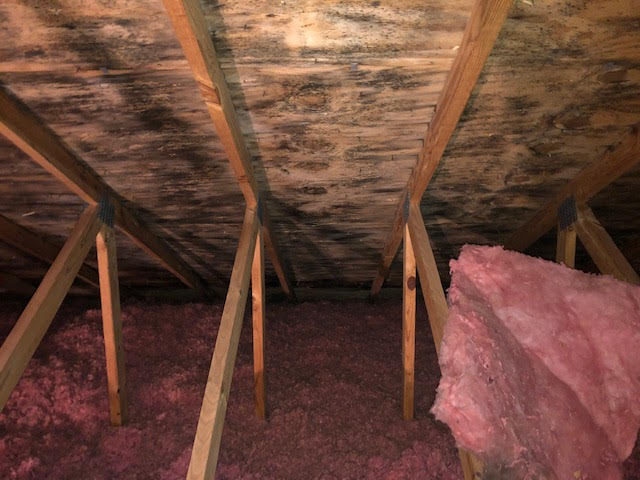
One of the most common calls I receive as a licensed mold assessor is concerning an individual who believes they have mold in their attic. This discovery can occur in several different ways. Sometimes it is found by a homeowner who happens to be getting a suitcase or Christmas tree out of the attic. Other times it is found by a contractor such as an HVAC technician or an alarm company installer. Most often, it is found by a home inspector during a house sale. The inspector will recommend further evaluation by a mold testing expert such as myself. On some occasions, the buyer will hire me and on others, it will be the seller.
In most cases, whoever sees the discoloration is positive that they are seeing mold, however, the reality of it is that there are times that what they’re seeing is not mold at all. Discoloration can be caused by water stains, carbon from fireplaces, heating systems or kitchens, or from other unrelated things. The fact of the matter is that no one can tell by merely looking at it. Samples need to be taken and submitted to a lab for analysis. A highly trained assessor then needs to interpret the results to determine whether remedial action is needed and if so, what specific kind.
There are two types of samples that are taken, swabs and air samples. Swabs address the visible
mold that initiated the concern while air samples are important to take when there are storage items up there, such as clothing, books, toys, furniture, sports equipment, and even HVAC fixtures. Even if there is surface mold on the sheathing and rafters, if it is not airborne, then cleaning is far easier and cheaper. That is what air sampling informs us of.
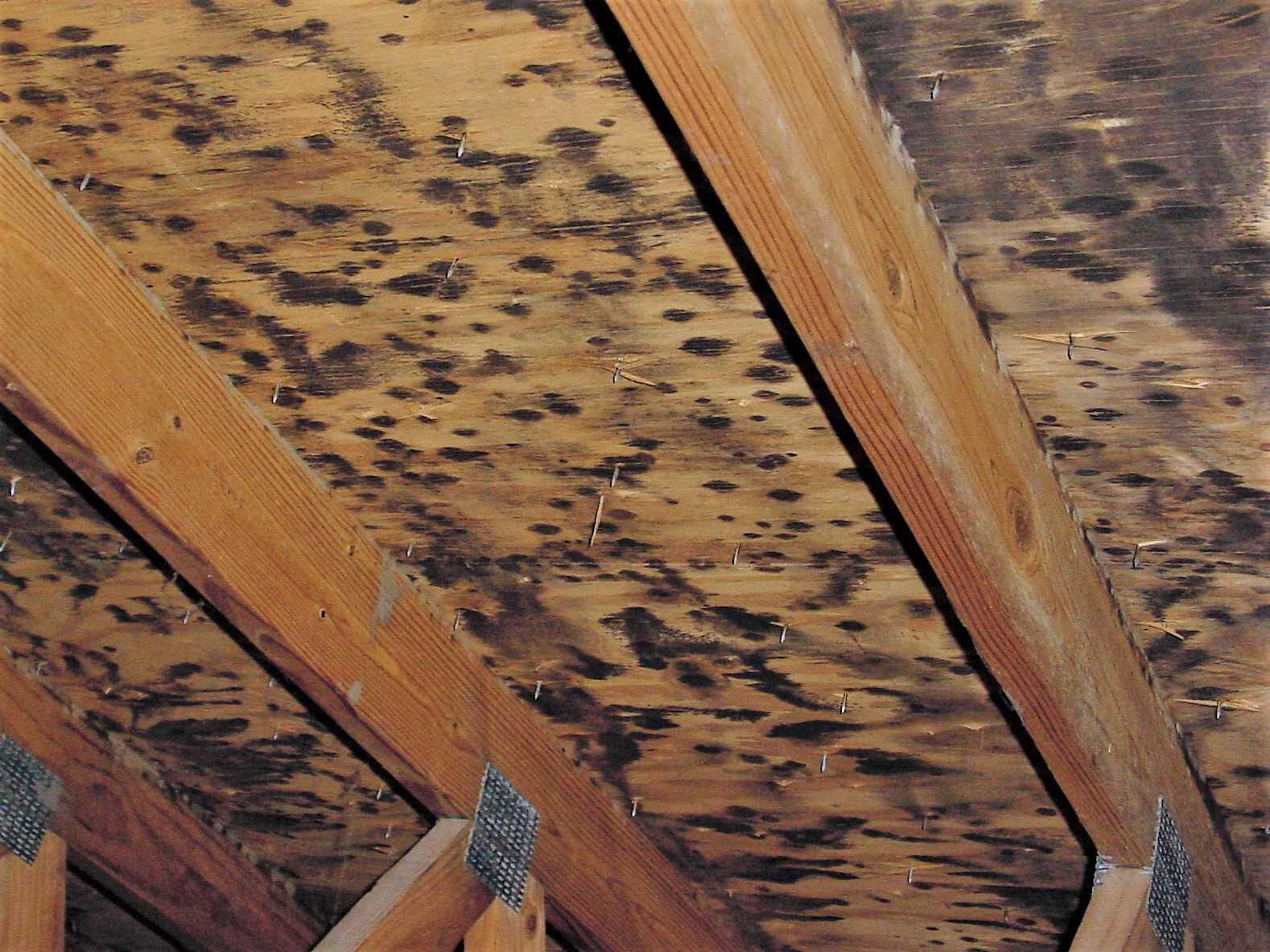
What causes mold in attics and why is it so common to find there?
 There are many reasons. First of all, there is a temperature differential between the attic and outside if the attic is not properly insulated and ventilated, so the differential causes condensation which is moisture, and moisture often attracts mold. Another reason is that the average household produces several gallons of moisture a day via showers, cooking, perspiration, and basement moisture that travels upward in what is known as “the stack effect.” Roof leaks and flashing leaks contribute to moisture and mold. Fan vents from bathrooms and kitchens that incorrectly terminate in the attic instead of outside bring moist air into the attic. Air conditioners sometimes get blocked or leaking condensate tubes and cause flooding. And sometimes, one side of the roof gets sunlight and the other doesn’t due to trees or other buildings blocking the sun. The sunny side will not have mold while the dark side will.
Protection against mold growth
 The best protection against mold growth in the attic is to have a proper roof ventilation system – typically a ridge vent and continuous, unimpeded soffit vents, and/or a mechanical venting system. A licensed engineer (PE) should be contacted for the proper design. Make sure no fan vents terminate in the attic. Make sure the insulation is up to current code and have an energy audit to find air leaks. And the roof should be inspected for any possible leaks.
Why you should hire a Mold Inspector?
Having an attic remediation can be a very expensive proposition. Valuable storage items may have to be thrown out, and all the insulation has to be removed and replaced. The wood has to be treated with a special chemical and sealant. The best advice I can give a homeowner is to follow the guidelines I outlined in this article and to call us to come for an evaluation. We will inspect, take samples and consult you on how to proceed with the safest, most confident path forward to protect your family’s health and well-being.
